
Doesn't Matter If You're Black or White (Unless, of Course, You're Black. Shamone.)
What Homer, Hollywood and two hundred years of translation reveal about race and imagination.

Every few months, Beyoncé’s internet discovers a new racial emergency.
A Black actor is cast in something. Someone declares history is under attack. The replies arrive. Thinkpieces are written (welp). Experts are summoned. We all spend five business days arguing about melanin as though civilisation itself hangs in the balance.
This time it’s Lupita Nyong’o as Helen of Troy.
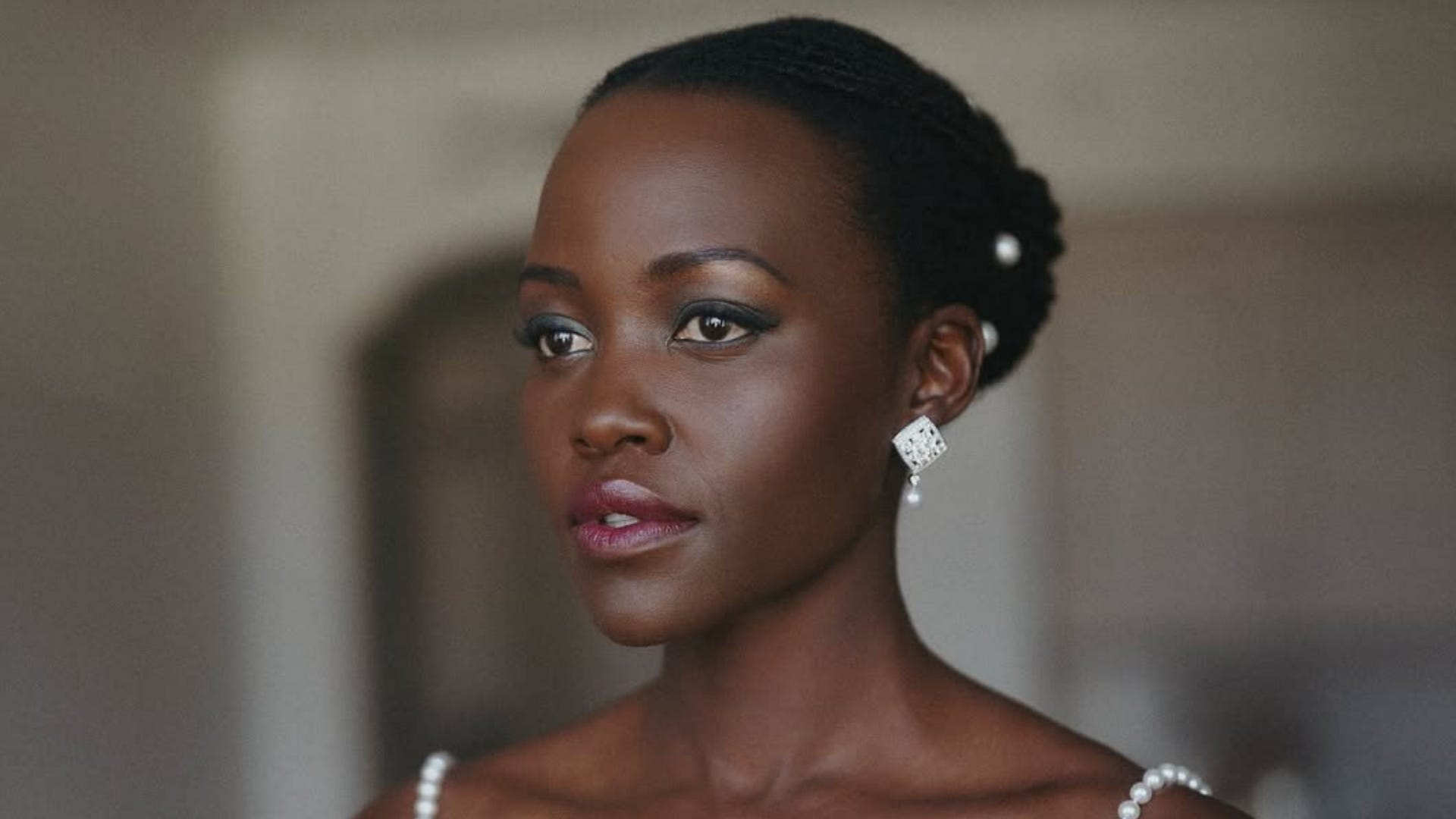
I’ve read some excellent responses. One article pointed out that Homer never called Helen “the most beautiful woman in the world”. That phrase comes from Sappho. It also highlighted something far more interesting: Homer describes Odysseus as black-skinned, yet for centuries translators have quietly softened that description into “bronzed”, “ruddy” or “tanned”. The same Greek root is translated as “black” when describing another character, but somehow becomes something more Mediterranean when applied to the hero.
It’s fascinating. It exposes how translators don’t simply translate words. They translate assumptions.
And yet, as I read it, I found myself wondering whether we were still trapped inside someone else’s question: Could Helen have been Black?
It’s a perfectly reasonable question. It’s just an exhausting one.
Because notice what happens every time these conversations arise. Black people are expected to produce evidence. Sources. Linguistic analyses. Archaeological findings. DNA studies. We become historians, classicists and genealogists simply to justify our presence in a fictional adaptation.
Whiteness, meanwhile, arrives without receipts.
No one cries about why Odysseus speaks English instead of ancient Greek. No one complains that Christopher Nolan has abandoned dactylic hexameter. Nobody objects to modern cinematography, orchestral scores or twenty-first-century psychology being inserted into an ancient epic.
Artistic licence is accepted everywhere except race.
Why?
Perhaps because Helen of Troy is more than a character. She is shorthand for beauty itself. For centuries, Western culture has treated her as the ultimate symbol of feminine desirability. So when Lupita Nyong’o is cast, the outrage isn’t really about Homer. It’s about who is allowed to embody beauty.
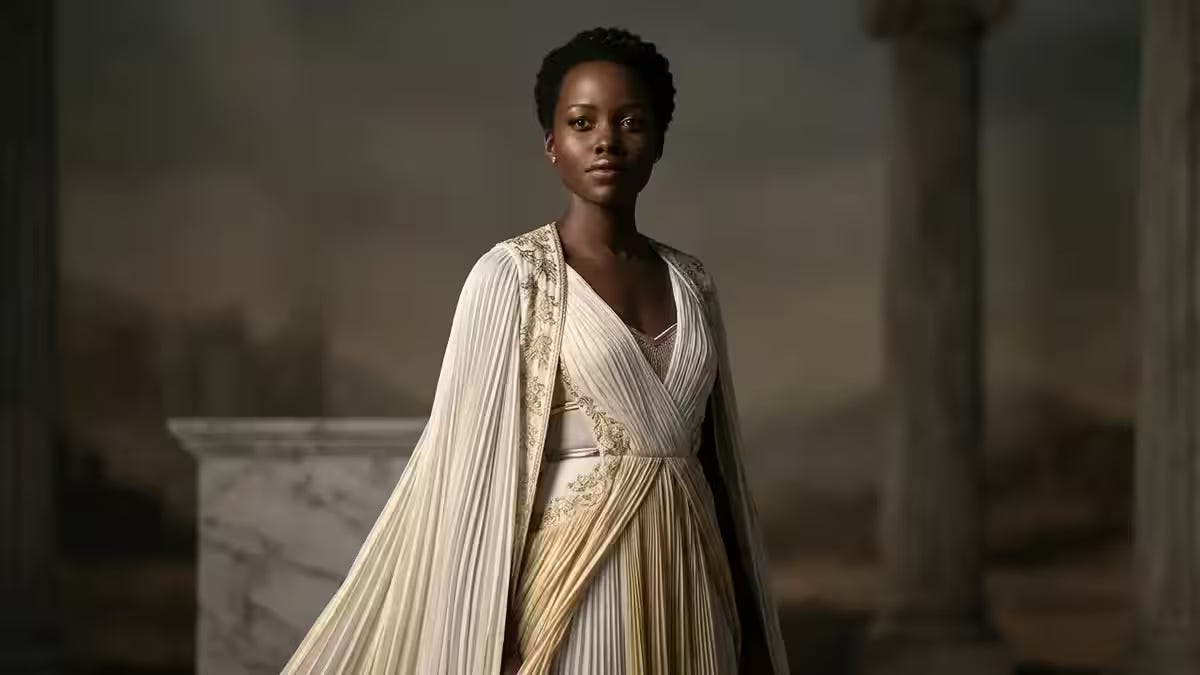
Hollywood has often struggled to cast dark-skinned Black women as the woman everyone wants. Not the maid. Not the best friend. Not God’s strongest soldier. The woman everyone wants.
The irony is that many of the people defending “historical accuracy” are defending an image of antiquity that isn’t ancient at all.
It’s Victorian.
The Greeks did not think about race the way we do. The Mediterranean wasn’t a sealed-off white continent waiting to invent civilisation in splendid isolation. It was a crossroads of Africa, Asia and Europe. Ideas, goods, languages and people moved constantly.
Much of what we imagine ancient Greece looked like comes from nineteenth-century Europe trying to make Greece look like itself.
That’s the real adaptation.
But we’re already making a strange assumption. That there is a single, authoritative Helen to be faithful to. There isn’t. The Greeks themselves couldn’t agree on Helen’s story.
In Homer, she goes to Troy.
In Herodotus's The Histories (Book 2), Egyptian priests tell a completely different version. Helen never reaches Troy at all. She remains in Egypt after the Egyptian king refuses to let Paris take her. The war is fought without her.
Then Euripides pushes the story even further. In his play Helen, the woman everyone believes is in Troy isn’t Helen at all. She’s an eidolon, a phantom double created by the gods. The real Helen has been waiting in Egypt the entire time while thousands of men kill each other over an illusion.
Think about that.
The ancient Greeks were perfectly happy to entertain the possibility that the Trojan War was fought over a ghost.
But some people now insist the unbelievable part is Lupita Nyong’o.
The irony is almost too good.
We’ve inherited the idea that myths have an original version. They didn’t. They had another storyteller. Somewhere along the way, we’ve come to believe there’s a definitive text against which every adaptation must be measured.
But myths didn’t work like that. They were living stories.
Every poet inherited them. Every playwright reshaped them. Contradictions weren’t mistakes to be corrected; they were part of the tradition. The point wasn’t to preserve a story in amber. It was to retell it.
Which makes all this talk of “fidelity” feel oddly modern.
Faithful to whom? Homer? Which Homer?
The oral tradition before the poems were written down? The Alexandrian editors? Medieval scribes? George Chapman? Alexander Pope? Emily Wilson?
Every generation has rewritten The Odyssey. Christopher Nolan isn’t breaking an unbroken chain of authenticity.
He’s joining it.
So perhaps the real question isn’t whether Helen could have been Black. It’s why we imagine there was ever a fixed Helen whose race could be protected.
Because that’s what these debates always reveal.
They invite us to spend our energy proving that we belong, rather than asking why belonging was ever restricted in the first place.
So perhaps the better question isn’t whether Helen could have been Black.
Perhaps it’s this:
Why do we instinctively experience Blackness as an interruption?
Why is whiteness treated as neutral while Blackness is treated as an interpretation?
Why does a Black actor require historical justification, while a white actor simply requires a casting announcement?
We already have the answer. It’s sitting in that Greek word from earlier, the one that means black skin whether it’s describing a hero or a herald. Translators didn’t struggle with the word. They struggled with where it landed.
Two hundred years of scholars looked at Odysseus and quietly decided: not him. Lupita Nyong’o is simply the latest reminder that imagination has politics.
I love how the text puts out that there wasn’t ever an original/ correct version of this myth but only several storytellers/ storylines/ perspectives.
And that is not only something that is true for worldly known myths it’s also true for the story countries/ communities tell others and themselves about their own history and their values. I think that might be what Christopher Nolan wanted to show us with THE ODYSSEY.